Hidden object games are tremendously popular amongst many gamers - the simple idea of finding listed items buried within a picture proved to be quite the hit with casual and hardcore gamers alike. The biggest example of the genre is the Mystery Case Files series - blending basic searching with a smattering of mini-game challenges and an intriguing storyline, the MCF games have spawned a sea of similar titles, with many major studios now jumping onto the bandwagon. Enter Season of Mystery: The Cherry Blossom Murders developed by Square-Enix in an attempt to reach the casual dollar.
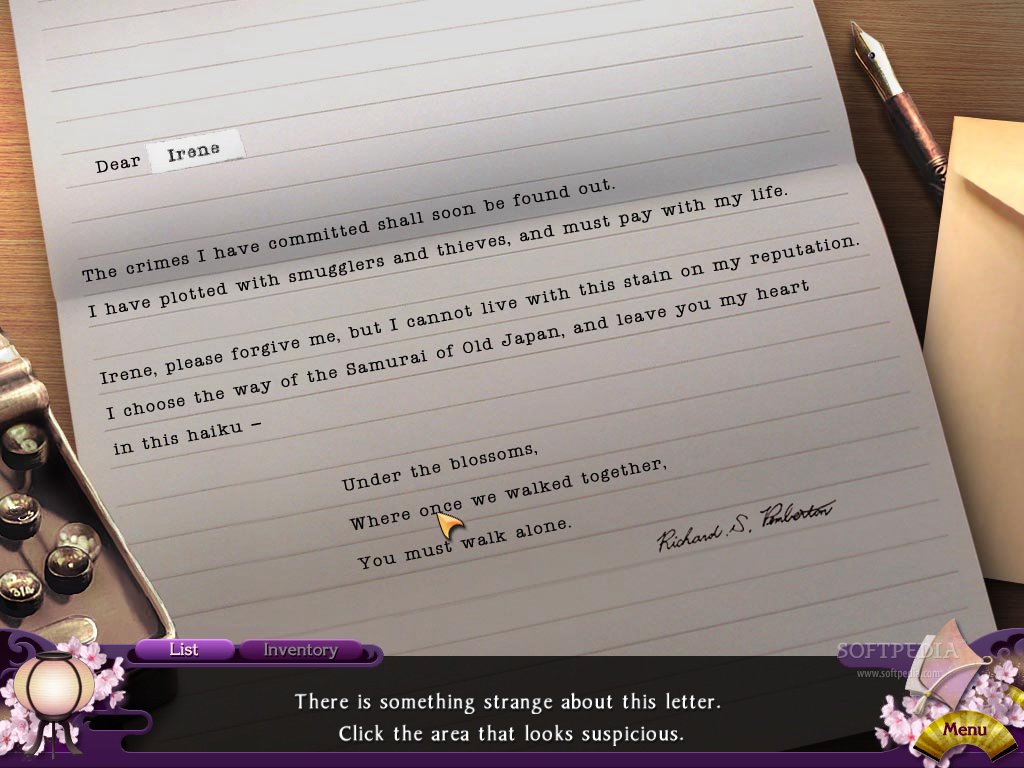
CBM is, quite simply, more of the same: offering an intriguing storyline and straightforward object hunting, it does exactly what it says on the tin. You take the role of Irene Pemberton, socialite wife of Richard, the American ambassador to Japan in the 19th century. Irene comes home to find her husband dead, with an apparent suicide note on his desk. However, clues point to the possibility of foul play, and the intrepid Irene sets off to prove a case of murder.
The basic blend of searching and mini-games remains untouched: you visit various areas, collecting listed objects to advance the story. Periodically, the game will present you with a different challenge (using clues to find a house on a map, for example, or piecing together a torn message or broken bottle) to break up the gameplay, all presented within the context of the storyline. If you get stuck, hints are liberally supplied too: just click on the object in your list, and the game will provide a silhouette to assist you. If you are still having trouble, you can click a button to reveal the objects location. The reveal button takes a few moments to recharge, so dissuades players from overusing it.
The graphics are acceptable for a low budget title: compared to many similar titles, objects blend quite well with the backgrounds, and a lot of the scenes are well drawn, despite everything having a low resolution look. However, many locations are reused several times, rendering later levels easier by virtue of learning the screen. This can happen with objects too, so the first pipe you find will invariably be the same later on. The game also falls into the trap of re-coloring and re-sizing objects to make them harder to find – this is a lazy approach, causing frustration when you need to use a hint to find a six foot tall harmonica, or a grey banana.
Sound is very minimalistic; gentle music plays in the background, and a few sound effects can be heard, but with no speech during cut scenes, and a lack of ambience, once again the title feels more budget than it should. This also prevents any characterisation with a basic script and no audio cues; even Irene (who is every scene) has no depth, and therefore lacks conviction.
The big problem with CBM is it fails to distinguish itself in a big field of similar titles: the story is a bit too bland, the actual gameplay doesn't do anything new, and the graphical style isn?t fresh enough to stand out. Unfortunately, this does nothing to dissuade the notion that this is an easy cash-in; adding the Square name to a basic hidden object title to seek a quick buck. An expansion of the core ideas and puzzles, some more plot, and some voices would benefit the title greatly, adding weight to the characters, and making the player feel more involved. The title suggests this is the first in a series, and I hope Square invests more time in the next title: there is a little promise here, but overall, CBM plays it far too safe, in a market overflowing with unoriginality.
Gameplay: 6.5
This is standard hidden object fare, offering no great deviations from the known formula. The plot adds reasons to continue, but this title is only for major fans of the genre.
Graphics: 6.5
Despite everything being presented in quite a low resolution, scenery is pleasant, and the colors are nice. Some objects suffer from being the wrong color or size in order to hide them, but most blend well with the backgrounds.
Sound: 4.0
There is a distinct lack of effort with the sound. Barring a clicking noise in the menus and game, and some very forgettable background music, there is no other sound at all.
Difficulty: Easy
Objects are hidden quite well, but there is no real punishment for clicking the wrong thing, and the mini-games break up the tempo. Many areas are reused with the same objects, so later levels become easier through repetition.
Concept: 3.0
It's a hidden object game: hundreds of similar titles exist, and CBM does nothing to distinguish itself from any others. Even the story is one told many times before, often in a better fashion.
Overall: 5.0
Season of Mystery: The Cherry Blossom Murders as a hidden object game is acceptable: the puzzles work, and the story is OK. However, there are literally hundreds of other titles offering a similar product to this, and apart from the publishers name featuring prominently; there would be no reason to pick this over any of the others.
Showing posts with label reviews. Show all posts
Monday
Friday
Blood Bowl Reviews
Normally, when you see dwarfs, wood elves, and orcs in a game, they aren’t swigging down pints of beer on a football field. But that’s exactly what sets Blood Bowl apart from its fantasy competition, as these carnivorous creatures have dropped their swords and hammers in favor of some good old-fashioned gridiron.
Blood Bowl takes mythical characters from the WarHammer universe and throws them into a specialized version of American football. Each race has their own strengths and weaknesses, as the wood elves are physically weak but great at passing while the orcs will crush the opposition’s defense but aren’t terribly reliable on offense. Each squad features the same basic player positions that are found in the NFL, though some of the added rules of Blood Bowl make things more interesting.
Blood Bowl lets you choose between real-time and turn-based play, a thankful addition that should appeal to many old-school tabletop fans. You are allowed to move each of your players a certain number of spaces each turn, pulverizing opponents and inching ever closer to the coveted end zone. Your turn ends once a player is knocked down or all of your characters have been moved. A roll of the die decides the fate of your opponents, and if they will be mangled, injured, murdered, or moved back a space. Beat that, Madden!
Further exploring the series’ RPG roots, player performance in Blood Bowl nets them experience, allowing them to eventually level up and earn new abilities. This adds a degree of reward to football that has never been there before, as each play can possibly lead to a greater advantage over the opposition.
While Blood Bowl’s unique spin on the rules of football can be very entertaining, some of this originality can lead to problems. For starters, the turn-based battle system takes some getting used to, and the complexity of the rules might turn off impatient sports fans who aren’t eager to learn. Sadly, the tutorials do a poor job of outlining the rules, forcing the player to figure things out on their own most of the time. This inevitably leads to frustration, and eventually, a controller being flung at a wall.
Also unfortunate is the the presentation, as it fails to live up to its ambitious concept. The camera utilizes some very odd angles, making it difficult to see the whole field and plan out your next move. The stadiums range from traditional, grassy farms to the hellish landscape of a burning city, but the blocky visuals do little to make these environments look interesting. The sound is equally mundane, though some humorous commentary does give the game a bit of personality. At the very least, it’s a far cry from the staid monotony of John Madden, and will give you some welcome auditory relief as you watch your orcs get clobbered into oblivion.
So while Blood Bowl’s conversion from board game to console experience is mostly successful, it might be a bit too complicated for most football fans. If you’re willing to stick with it however, Blood Bowl offers a fist full of bloody, gutsy fun, and a welcome change of pace from the EA Sports lineup.
Blood Bowl takes mythical characters from the WarHammer universe and throws them into a specialized version of American football. Each race has their own strengths and weaknesses, as the wood elves are physically weak but great at passing while the orcs will crush the opposition’s defense but aren’t terribly reliable on offense. Each squad features the same basic player positions that are found in the NFL, though some of the added rules of Blood Bowl make things more interesting.
Blood Bowl lets you choose between real-time and turn-based play, a thankful addition that should appeal to many old-school tabletop fans. You are allowed to move each of your players a certain number of spaces each turn, pulverizing opponents and inching ever closer to the coveted end zone. Your turn ends once a player is knocked down or all of your characters have been moved. A roll of the die decides the fate of your opponents, and if they will be mangled, injured, murdered, or moved back a space. Beat that, Madden!
Further exploring the series’ RPG roots, player performance in Blood Bowl nets them experience, allowing them to eventually level up and earn new abilities. This adds a degree of reward to football that has never been there before, as each play can possibly lead to a greater advantage over the opposition.
While Blood Bowl’s unique spin on the rules of football can be very entertaining, some of this originality can lead to problems. For starters, the turn-based battle system takes some getting used to, and the complexity of the rules might turn off impatient sports fans who aren’t eager to learn. Sadly, the tutorials do a poor job of outlining the rules, forcing the player to figure things out on their own most of the time. This inevitably leads to frustration, and eventually, a controller being flung at a wall.
Also unfortunate is the the presentation, as it fails to live up to its ambitious concept. The camera utilizes some very odd angles, making it difficult to see the whole field and plan out your next move. The stadiums range from traditional, grassy farms to the hellish landscape of a burning city, but the blocky visuals do little to make these environments look interesting. The sound is equally mundane, though some humorous commentary does give the game a bit of personality. At the very least, it’s a far cry from the staid monotony of John Madden, and will give you some welcome auditory relief as you watch your orcs get clobbered into oblivion.
So while Blood Bowl’s conversion from board game to console experience is mostly successful, it might be a bit too complicated for most football fans. If you’re willing to stick with it however, Blood Bowl offers a fist full of bloody, gutsy fun, and a welcome change of pace from the EA Sports lineup.
Subscribe to:
Posts (Atom)